What gets recorded and how analysis works
Recorded for every session
Per session: project, branch, Claude Code version, start/end, wall and active time (idle gaps over
15 min excluded), human prompts (including ones queued while Claude worked), slash commands,
interrupts, compactions, every tool call with duration and success, files read/edited with
line counts, subagents and workflows with their own usage, skills, MCP servers, hooks, PRs and
artifacts, and token usage per API call (deduplicated per message) with an API-list-price cost
estimate. Estimates match Claude Code's own cost-state to the cent for single-process sessions;
subscription billing differs.
Per analyzed session: title, summary, goal, outcome, work types, tags, highlights, open threads, friction, sentiment, and knowledge items:
| Kind | Meaning |
|---|---|
| fix | a failure, its root cause, and the fix |
| gotcha | a pitfall and how to avoid it |
| learning | an insight about a technology or the codebase |
| decision | a design choice and its rationale |
| pattern | a reusable technique or snippet |
| command | a useful invocation |
| fact | project layout, config, endpoints, deployment |
| preference | how you want Claude to work |
| reference | an external pointer |
| todo | a follow-up |
Claude's own auto-memory notes (projects/*/memory/*.md) and Codex's memory notes are imported as knowledge too.
Codex, Copilot and Bob sessions fill the same fields wherever their logs carry the data: Copilot Chat logs, for instance, have no cache split (so no cost estimate), and Bob tasks have no per-call timings.
How analysis works
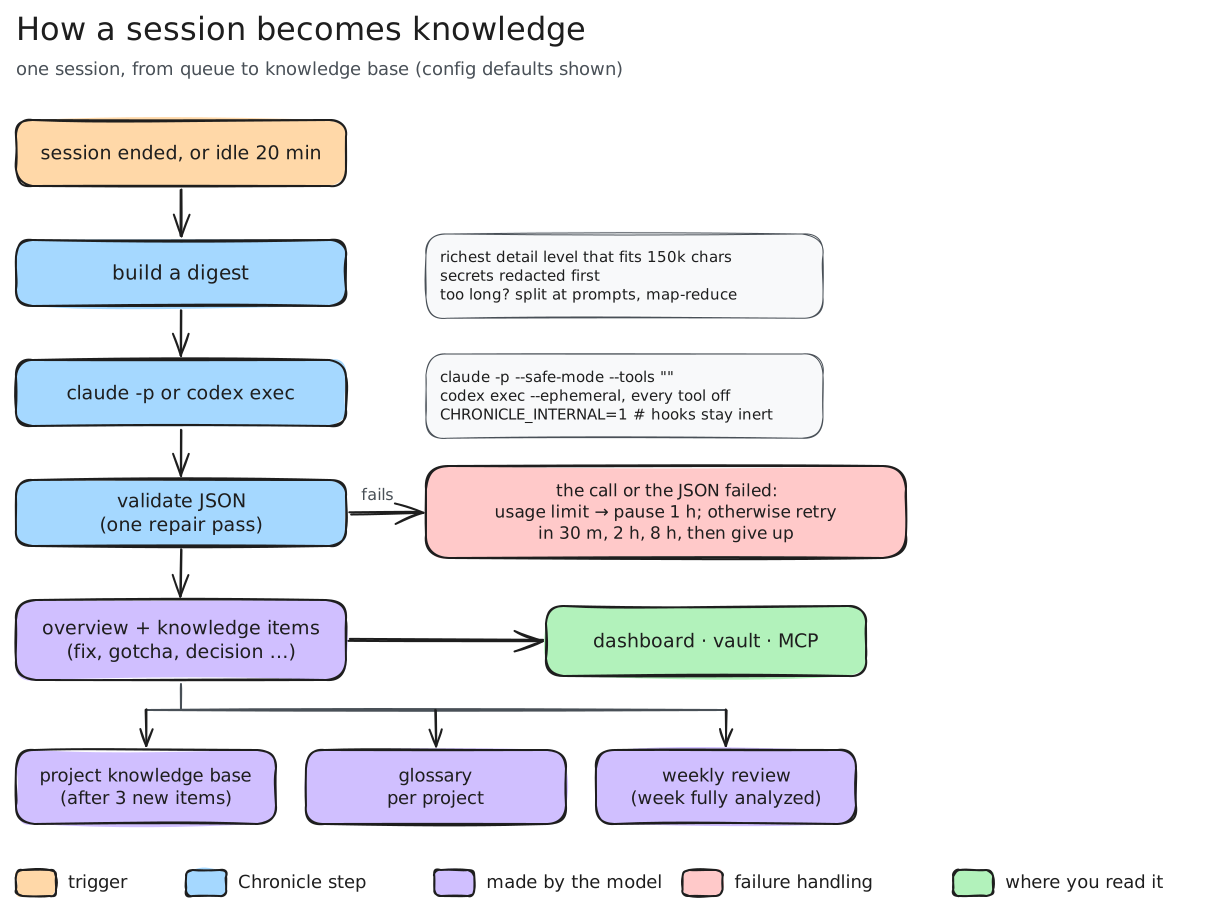
- A session is queued once it ends (hook) or has been idle for
idle_minutes. - The transcript is condensed into a digest at the richest detail level that fits
chunk_chars(full prompts and replies, one line per tool call, error excerpts, subagent reports). Very long sessions are split at prompt boundaries and map-reduced. Secrets are redacted first. - The digest goes to the agent chosen in
analysis.backend, through your own login, sandboxed so that no session is written for the analysis itself, none of your hooks, plugins, MCP servers or instruction files load, and the model can only answer: - Claude Code (
backend = "claude", the default):claude -p --no-session-persistence --safe-mode --tools "" --strict-mcp-config. - Codex (
backend = "codex"):codex exec --ephemeral --ignore-user-config --sandbox read-only, with every tool feature switched off (shell, code execution, sub-agents, apps, plugins, web search, images), hooks,AGENTS.mdand skill instructions off, and Chronicle's instructions in place of Codex's own. Codex cannot switch off every tool by flag, so Chronicle also reads its event stream: a reply that follows any tool call is thrown away and the analysis counts as failed.
CHRONICLE_INTERNAL=1 makes Chronicle's own hooks inert for these runs. Switch agents in Status ›
Analysis, with chronicle config set analysis.backend codex, or for one run with chronicle analyze
--backend codex.
4. The JSON reply is validated leniently (with one repair pass) and stored. When a project gains
min_new_items new items, its knowledge base is re-synthesized; items that are outdated or
duplicated get marked superseded (pinned and memory items are never superseded). Once every session of
a finished week is analyzed, the model writes that week's review (a three-line TL;DR, themes, accomplishments,
learnings, open threads, recurring friction, concrete workflow suggestions). Knowledge bases, the playbook and
reviews are written to be skimmed: a TL;DR, a short overview, a title per knowledge-base bullet, and word
limits on every field. The review's numbers and charts come from the database, not from the model.
5. Usage-limit or auth errors pause analysis for an hour; other failures back off 30 min → 2 h → 8 h.
Calls have a wall-clock deadline, and a call frozen by the Mac going to sleep is killed right after wake and
re-queued without counting as a failure. Sessions that continue after being analyzed are re-analyzed.
Cost: analysis runs through your own Claude Code or Codex login. With Claude, the reported cost is the API
list-price equivalent: sessions averaged about $0.38 each with Sonnet (digests average ~150k characters), and
max_budget_usd caps each call. Codex reports tokens but no price, so Codex analyses show no cost. On a Claude or
ChatGPT subscription the usage is drawn from the plan's allowance rather than billed. chronicle analyze --pending
--dry-run sizes a backlog before you spend anything.